
Table of Contents
ToggleWhen the heat becomes unbearable, and permanent HVAC systems can’t keep up or simply aren’t an option, a portable air conditioner delivers fast, flexible and targeted cooling exactly where you need it. From sweltering home offices and server rooms running hot to outdoor weddings and active construction sites, portable cooling has become an important option for temporary, supplemental and emergency climate control.
Extreme heat events are more frequent and more intense, aging HVAC equipment tends to fail at the worst possible moment, and businesses increasingly need cooling that can move, scale, and deploy within hours.
That is where portable air conditioning proves its value. Rental equipment also gives homeowners and organizations access to commercial-grade performance without a large upfront investment.
In this guide, you’ll learn how portable air conditioners work, the different types available, how to size a unit correctly, the features that matter most, and how to install and maintain your equipment for peak efficiency. We’ll also cover when renting beats buying, how emergency cooling rentals keep operations running during a crisis, and where a Portacool air conditioner fits into the picture.
What is a Portable Air Conditioner?
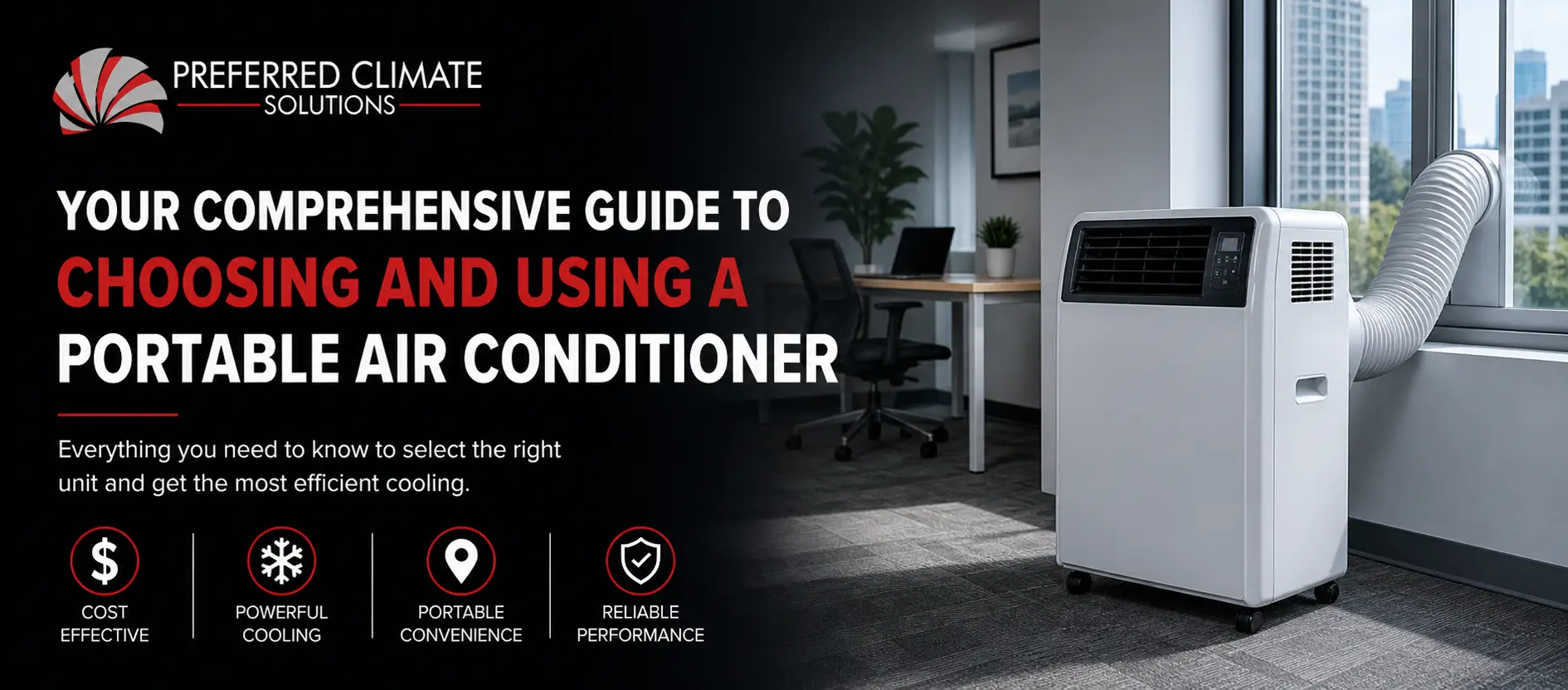
A portable air conditioner is a self-contained and freestanding cooling unit that can be moved from space to space and set up without permanent installation. Instead of being mounted in a wall or ducted into a building, it rests on the floor, rolls on casters, and vents warm air through a flexible exhaust hose.
This makes it ideal for environments where a fixed system is impractical, prohibited by a lease, or simply not worth the cost.
How a Portable Air Conditioner Works
A portable air conditioner cools using the same refrigeration principles as any other AC system, packaged into one mobile enclosure. The process comes down to three actions working together:
- Air Circulation: The unit draws warm indoor air across a cold evaporator coil, chilling it before pushing it back into the room.
- Heat Exhaust: The heat absorbed from that air is expelled outdoors through an exhaust hose, typically routed through a window kit, drop ceiling, or wall vent.
- Moisture Removal: As warm air passes over the coil, humidity condenses and is either collected in a reservoir, dispersed through a self-evaporative system or removed through a continuous drain, improving comfort alongside temperature.
Types of Portable Air Conditioners
- Single Hose Units: Use one hose to exhaust hot air. Affordable and simple, they’re best suited to small rooms and light-duty use.
- Dual-Hose Units: One hose pulls in outside air to cool the condenser while the other exhausts heat, delivering faster and more efficient cooling in larger or hotter spaces.
- Commercial Portable AC Units: Higher-capacity machines built for offices, retail floors, and light industrial settings.
- Industrial Cooling Systems: Heavy-duty and high-BTU equipment engineered for warehouses, manufacturing, and process cooling.
- Spot Coolers: Deliver concentrated cooling directly at people or equipment, a common choice for server rooms, workshops, and rapid-response cooling.
Portable Air Conditioner vs. Window AC vs. Central Air: A Quick Guide
|
Factor |
Portable Air Conditioner |
Window AC |
Central Air |
|
Installation |
No permanent installation; vents through a window or ceiling |
Mounted in a window frame |
Professional and ducted installation |
|
Mobility |
Fully mobile and rolls between rooms |
Fixed to one window |
Permanent |
|
Cost |
Low to moderate upfront cost |
Low upfront cost |
High upfront and installation cost |
|
Cooling Capacity |
Spot and single-zone cooling |
Single-room cooling |
Whole-building cooling |
|
Best Applications |
Temporary, targeted, or supplemental cooling |
One dedicated room |
Entire homes and facilities |
For flexibility and speed of deployment, a portable air conditioner is hard to beat, especially when paired with a rental model that removes ownership and maintenance burdens entirely.
Why Businesses and Homeowners Choose a Portable Air Conditioner
Residential Applications
Homeowners rely on portable units to cool the spaces that need it most without overhauling their whole system.
Common uses include bedrooms for better sleep, living rooms during heat waves, apartments where window AC isn’t permitted, garages used as workshops or gyms, and home offices where comfort directly affects productivity.
Commercial Applications
For businesses, a portable air conditioner solves cooling gaps quickly. Typical applications include offices with uneven temperature zones, retail stores managing foot traffic and heat, warehouses using spot coolers for targeted work zones and equipment areas, manufacturing facilities protecting workers and equipment, restaurants cooling hot kitchen areas, and data centers keeping sensitive servers within safe operating temperatures.
Outdoor and Temporary Cooling
Event and project environments benefit enormously from mobile cooling. Portable and evaporative units keep guests comfortable at weddings, festivals, and sporting events, while ruggedized systems support construction sites and tent events where no fixed infrastructure exists.
When is Portable Air Conditioner Rental the Better Option?
Not every cooling need justifies buying equipment outright. For temporary, seasonal, or high-capacity requirements, a portable air conditioner rental is often the smarter financial and operational choice.
Benefits of Renting Instead of Buying Portable Air Conditioners
- Lower Upfront Cost: Avoid a large capital purchase for equipment you may only need briefly.
- No Maintenance Responsibility: The rental provider handles servicing, repairs, and upkeep.
- Access to Commercial Grade Equipment: Rent high-output units you wouldn’t purchase for occasional use.
- Flexible Rental Terms: Scale up or down as demand changes.
- Seasonal Needs: Cover peak summer months without year-round ownership costs.
Industries that Frequently Use Portable Air Conditioner Rentals
A portable air conditioner rental is a staple across healthcare, education, hospitality, manufacturing, government facilities, construction, and event management sectors where cooling demand spikes, shifts location, or must be deployed on short notice.
Situations Where Rentals Make Sense
Renting is especially practical during HVAC breakdowns, renovation projects, peak summer demand, temporary office spaces, and server room cooling. It’s perfect for any scenario where you need reliable cooling now, but permanent equipment doesn’t fit the timeline or budget.
Understanding BTU Capacity and Cooling Performance
What BTU Means
BTU (British Thermal Unit) measures how much heat an air conditioner can remove from a space in one hour. The higher the BTU rating, the larger the area a unit can cool effectively.
Choosing the right BTU capacity is essential for efficient cooling. If you choose a unit with too few BTUs, it will struggle to cool the space, run continuously, and use more energy while still leaving the room uncomfortable.
If you choose a unit with too many BTUs, it will cool the room too quickly and shut off before removing enough humidity, leaving the air feeling damp and clammy. Selecting the correct BTU rating helps maintain consistent temperatures, improves energy efficiency, and creates a more comfortable indoor environment.
Factors that Affect Cooling Capacity
Square footage is only the starting point. Real-world capacity is shaped by room size, ceiling height, occupancy (people generate heat), equipment heat from computers and machinery, sun exposure through windows, and insulation quality. A room full of servers or direct afternoon sun may need significantly more capacity than its floor area suggests.
Portable Air Conditioner Sizing Guide
|
Room Size |
Recommended BTUs |
|
100 – 150 sq. ft. |
5,000 BTU |
|
150 – 250 sq. ft. |
6,000 – 7,000 BTU |
|
250 – 350 sq. ft. |
8,000 – 10,000 BTU |
|
350 – 450 sq. ft. |
10,000 – 12,000 BTU |
|
450 – 550 sq. ft. |
12,000 – 14,000 BTU |
|
550 – 700 sq. ft. |
14,000 – 16,000 BTU |
As a rule of thumb, add roughly 10% capacity for sunny rooms, high ceilings, or heavy occupancy, and step up further for spaces packed with heat-generating equipment.
Key Features to Look for in a Portable Air Conditioner
- Energy Efficiency: Look for high CEER/EER ratings and inverter compressors to lower operating costs.
- Cooling Capacity: Match BTU output to your space and heat load, not just floor area.
- Noise Levels: Check decibel ratings for bedrooms, offices, and other quiet environments.
- Smart Controls: Wi-Fi and app connectivity allow remote adjustment and scheduling.
- Programmable Timers: Cool only when needed to cut energy use.
- Dehumidification Functions: A built-in dehumidifier mode improves comfort in humid climates.
- Multiple Fan Speeds: Fine-tune airflow and cooling to conditions.
- Easy Mobility: Sturdy casters and manageable weight make repositioning simple.
- Drainage Options: Self-evaporative or continuous drain systems reduce manual emptying.
- Air Filtration: Washable and HEPA-style filters improve air quality while protecting the unit.
How to Properly Install and Use a Portable Air Conditioner
- Choosing the Best Location: Place the unit near a window or vent point and away from obstructions, ideally in the warmest part of the room.
- Proper Venting Methods: Keep the exhaust hose as short and straight as possible, and seal the window kit tightly so hot air doesn’t recirculate.
- Temperature Settings for Maximum Efficiency: Set a moderate target temperature rather than the lowest possible; every degree lower increases energy usage.
- Optimizing Airflow: Keep vents unobstructed, close doors to the cooled space, and use fans to distribute cool air evenly.
- Tips to Reduce Energy Consumption: Close blinds during peak sun, run programmable timers and seal gaps around doors and windows, and clean filters regularly.
Portable Air Conditioner Maintenance Tips
- Cleaning Air Filters: Wash or replace filters every two to four weeks during heavy use to maintain airflow and efficiency.
- Emptying Condensate: Drain the reservoir as needed, or connect a continuous drain hose for long runs.
- Inspecting Exhaust Hoses: Check for kinks, gaps, and leaks that let heat back into the room.
- Seasonal Maintenance: Clean coils and inspect components before peak cooling season begins.
- Storage Tips: Drain fully, dry the interior, and store the unit upright in a cool and dry place to prevent mold and mechanical issues.
Advantages of Portable Air Conditioner Rentals for Businesses
- Lower Capital Investment: Preserve cash flow by avoiding equipment purchases for temporary needs.
- Fast Equipment Deployment: Get units delivered and running quickly, minimizing downtime.
- Scalable Cooling Solutions: Add or remove capacity as projects and seasons demand.
- Reduced Maintenance Costs: Servicing and repairs are the provider’s responsibility, not yours.
- Flexible Rental Periods: Choose daily, weekly, monthly, or seasonal terms that fit your operation.
Renting turns a large and fixed expense into a predictable and on-demand service, a major advantage for facilities balancing tight budgets against unpredictable cooling needs.
Common Mistakes to Avoid When Using a Portable Air Conditioner
- Choosing the Wrong BTU Size: Undersizing leaves rooms warm; oversizing wastes energy and leaves air humid.
- Poor Venting: Long, kinked, or unsealed hoses let heat recirculate and cripple performance.
- Blocking Airflow: Furniture and clutter in front of vents reduce cooling reach.
- Ignoring Filter Maintenance: Dirty filters restrict airflow and strain the compressor.
- Incorrect Temperature Settings: Setting the thermostat too low increases cost without cooling faster.
- Overlooking Insulation: Gaps around doors and windows let cool air escape and hot air in.
Why Choose Preferred Climate Solutions for Portable Air Conditioner Rentals
- Commercial-Grade Cooling Equipment: A fleet of reliable and high-performance units for demanding environments.
- 24/7 Emergency Cooling Rentals: Around-the-clock response when downtime isn’t an option.
- Fast Delivery and Setup: Equipment on site and running quickly to keep you comfortable and operational.
- Experienced Cooling Specialists: Expert guidance on sizing, placement, and configuration.
- Flexible Rental Solutions: Terms tailored to your timeline, from short projects to full seasons.
- Temporary Cooling for Any Industry: Solutions for healthcare, education, hospitality, manufacturing, events, and more.
In Conclusion
Selecting the right portable air conditioner means considering the size of your space, cooling capacity, energy efficiency, and intended application. Whether you need temporary cooling for a commercial facility, industrial site, special event, or emergency situation, renting the right equipment can provide reliable performance while eliminating the costs and maintenance associated with ownership.
As a trusted Portacool air conditioner rental provider, Preferred Climate Solutions delivers commercial-grade cooling solutions, flexible rental options, and rapid response services to help businesses maintain safe, comfortable, and productive environments.
Contact us today to connect with our experienced cooling specialists. We’ll assess your cooling requirements, recommend the right portable air conditioner rental or Portacool air conditioner solution, and provide fast and reliable service to keep your facility comfortable, productive, and operating without interruption. From Austin and Dallas to Houston, businesses across Texas rely on dependable cooling when temperatures rise or unexpected HVAC failures occur.
Frequently Asked Questions (FAQs)
What size portable air conditioner do I need?
Match BTU output to your room size and heat load. As a baseline, a 250 – 350 sq. ft. room needs roughly 8,000 – 10,000 BTU, but always add capacity for high ceilings, strong sun, heavy occupancy, or heat-generating equipment.
Is portable air conditioner rental better than buying?
For temporary, seasonal or emergency needs, renting is usually better because it avoids high upfront costs, includes maintenance and provides access to commercial-grade units.
Can a portable air conditioner cool multiple rooms?
A single unit is designed to cool one zone effectively. It can help adjacent open areas, but for multiple enclosed rooms, you’ll get far better results using multiple units or a higher-capacity system.
How long can a portable air conditioner run continuously?
Most units are built to run continuously as long as condensate is managed through self-evaporation or a continuous drain. Keep filters clean and the exhaust unobstructed to support extended operation.
Are emergency cooling rentals available 24/7?
Yes. Reputable providers offer emergency cooling rentals around the clock, with fast delivery and setup so you can restore safe conditions during HVAC failures, heat waves, or equipment overheating at any hour.
What is the difference between a portable air conditioner and a Portacool air conditioner?
A portable air conditioner uses refrigerant, removes humidity, requires venting, and works indoors in any climate. A Portacool air conditioner uses evaporative cooling, adds humidity, needs no venting, and performs best in dry, open, or outdoor environments.
Do portable air conditioners require professional installation?
No. One of their biggest advantages is easy and tool-free setup: position the unit, attach the exhaust hose through a window or vent, and plug it in. This is a key reason rentals can be deployed within hours.
Are portable air conditioners energy efficient?
Modern units with high efficiency ratings, inverter compressors, and programmable timers can be very efficient. Correct sizing, clean filters, and proper venting have the greatest impact on real-world energy use.
Can a portable AC cool a server room?
Yes. A portable AC can effectively cool a server room by providing temporary or supplemental cooling to help protect equipment from overheating.
What information is needed for a portable AC rental quote?
To provide an accurate quote, you’ll typically need the location, space size, application, rental duration, and available power supply.