
Table of Contents
ToggleDrywall dust, mold spores, smoke particles, and some odors or vapors can move beyond the immediate work area. They drift into hallways, offices and HVAC returns, and the people breathing them are your crews, tenants and customers. That is where temporary air filtration can help.
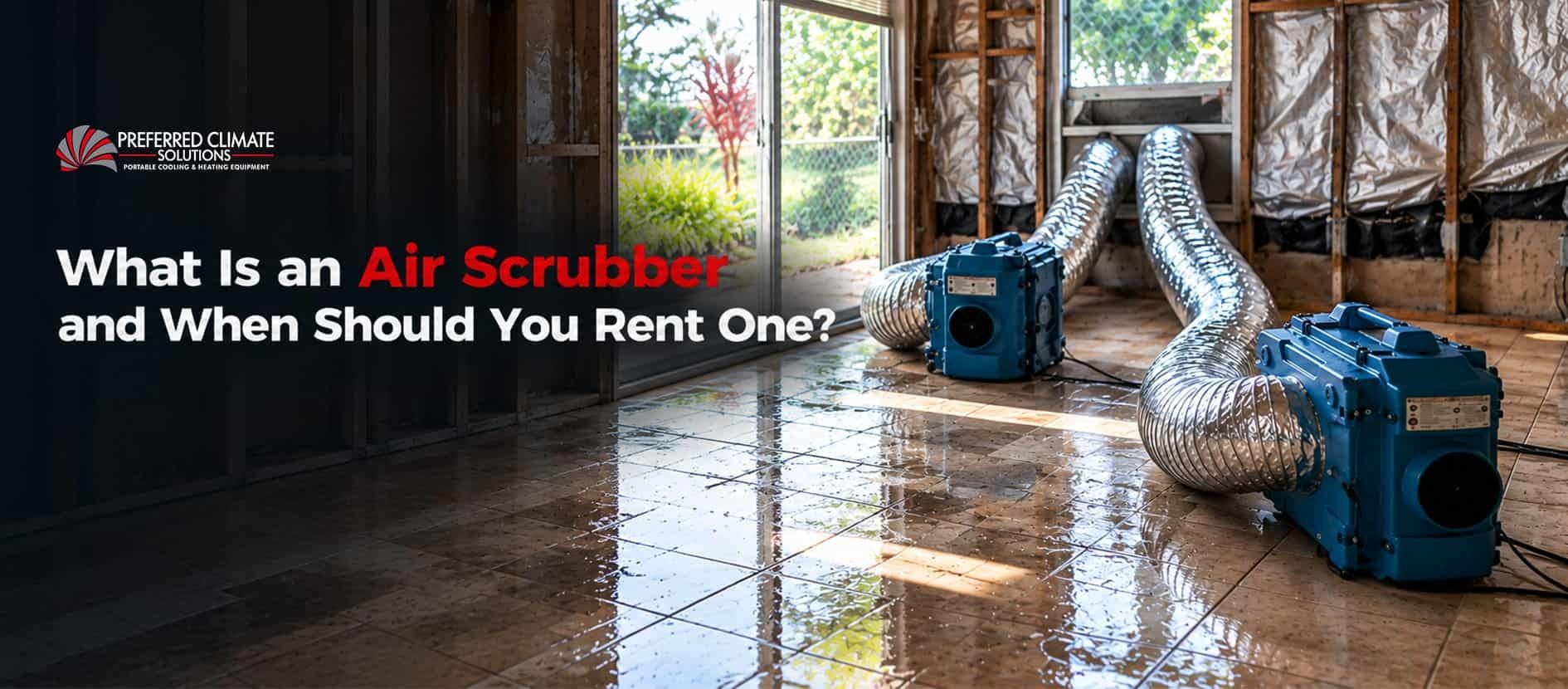
So, what is an air scrubber? An air scrubber is a portable air-filtration machine that pulls airborne particles through one or more filters, often ending with a HEPA filter, and returns filtered air to the space. Contractors, restoration crews, and facility managers use air scrubbers to help control airborne dust and particulates during construction, remediation, and cleanup. Some units can also use activated carbon media to reduce certain odors and fases. Contractors, restoration crews and facility managers use them to control airborne dust and contaminants during construction, remediation and cleanup. Most businesses don’t need one year-round, which is why HEPA air scrubber rental is the usual choice.
This guide explains how air scrubbers work, how they compare to air purifiers and negative air machines, when you should rent one, and how to choose the right size.
How Does an Air Scrubber Work?
An air scrubber uses a powerful fan to pull room air through multiple filter stages:
- Pre-Filter: Catches large dust and debris and protects the more expensive filters behind it.
- Secondary Filter: Traps intermediate-size particles such as fine construction dust.
- HEPA Filter: Captures fine airborne particles, including many mold spores, dust particles, and other particulates, depending on particle size and filter performance.
According to the EPA, True HEPA filter filters are commonly rated to capture at least 99.97% of particles at 0.3µm under the applicable test standard.
What does an air scrubber do about odors? HEPA filters trap particles, not gases. HEPA filters capture particles, not gases. Activated carbon media may help reduce certain odors, smoke-related gases, and VOCs, but performance depends on the containment, filter capacity, airflow, and how saturated the carbon becomes. Hazardous chemical vapors may require specialized gas-phase filtration or source-control measures. The DefendAir HEPA 500, for example, pairs true HEPA filtration with a carbon stage for odors and VOCs.
Air Scrubber vs. Air Purifier vs. Negative Air Machine
These three terms get mixed up, but they do different jobs.
| Air Purifier | Air Scrubber | Negative Air Machine | |
|---|---|---|---|
| Built For | Homes and small offices | Job sites and commercial spaces | Containment areas |
| Typical Airflow | Under 500 CFM | 500 to 2,000+ CFM | 500 to 2,000+ CFM |
| What it Does with Clean Air | Returns it to the room | Returns it to the room | Ducts it outside the work area |
| Main Purpose | Everyday air quality | Cleaning heavily contaminated air | Keeping contaminants from escaping |
In short, an air purifier is a consumer appliance, while a portable air scrubber is a rugged commercial machine with often higher airflow capacity. Our full breakdown of air scrubbers vs. air purifiers covers the details.
The line between an air scrubber and a negative air machine is thinner. Many commercial units can do both jobs. As a scrubber, the unit sits inside the room and recirculates clean air. When configured for negative-air containment, the unit exhausts filtered air outside the work zone. Combined with appropriate barriers, controlled makeup air, ducting, and pressure monitoring, this can help maintain lower pressure inside the containment area and reduce the movement of contaminated air into adjacent spaces.
When Should You Rent an Air Scrubber?
An air scrubber may be appropriate when a temporary project is generating significant airborne particles and the work needs high-volume filtration. Common examples include construction, demolition, remediation, restoration, and containment work. These are the most common situations.
Construction and Renovation
Cutting drywall, sanding, demolition and concrete work all create fine dust. A construction air scrubber can help reduce airborne dust during construction. Combined with source control, containment, and appropriate HVAC protection measures, it can help limit particulate migration into adjacent areas at the end of the job.
Mold Remediation
Disturbing mold releases spores into the air. A HEPA air scrubber for mold remediation captures them during removal, and when properly configured with containment barriers, ducting, airflow control, and pressure verification, negative-air equipment can help reduce the movement of airborne spores from the work zone into adjacent spaces. Our negative air machine rental guide explains how to set up containment.
Water Damage and Burst Pipes
Prolonged moisture can create conditions that support mold growth, and drying stirs up dust and debris. Water-damaged drying typically relies on extraction, air movement, dehumidification, and moisture monitoring. Air scrubbers may be added when demolition, microbial remediation, or other cleanup activities create airborne particulates that need filtration. Our guide to burst pipe cleanup after a freeze walks you through the full process.
Hospitals and Healthcare Facilities
Even small maintenance jobs above a ceiling can expose patients to dust and fungal spores. Mobile containment units like the HC55U-L containment cart combine an enclosure with a built-in negative air machine for this kind of work.
Healthcare applications should follow the facility’s infection-control, containment, filtration, and pressure requirements.
Smoke, Odor and Fumes
Fire cleanup, painting, floor refinishing and chemical work leave odors and VOCs behind. An industrial air scrubber with a carbon filter clears the air faster than opening windows, especially in buildings with sealed windows.
How to Choose the Right Size Air Scrubber
Air scrubbers are sized by airflow in cubic feet per minute (CFM). The goal is to process a volume of air equivalent to the room volume a set number of times per hour, called air changes per hour (ACH).
Use this formula:
Required CFM = (Room Length × Width × Ceiling Height × Target ACH) ÷ 60
Here’s an example. A 2,000sq. ft. space with 10ft ceilings holds 20,000 cubic feet of air. At 6 air changes per hour, you need 20,000 × 6 ÷ 60 = 2,000 CFM. That’s one 2,000 CFM unit like the PCS-2000, or four 500 CFM units spread around the space.
Note: This is a planning estimate. Actual delivered airflow may be lower because of filter loading, ducting, static pressure, equipment placement, and containment condition.
A few practical tips:
- Target ACH depends on the project type, contaminant load, containment design, and any applicable specifications or facility requirements. Some projects may use planning ranges such as 4-6 ACH, while remediation, healthcare, or other controlled environments may require different targets.
- As filters load with particles, airflow and system performance can decline, so filter conditions should be monitored throughout the project.
- Multiple smaller units may provide better airflow distribution in large, divided, or irregularly shaped spaces, depending on placement and the containment plan.
Should You Rent or Buy a Commercial Air Scrubber?
Renting often makes sense for businesses that only need air scrubbers for temporary projects, emergencies, or occasional remediation work. Air quality projects usually last days or weeks, and the number of units you need changes from one job to the next. Renting also means:
- No large upfront cost or storage space.
- Units arrive with fresh filters and tested equipment.
- You can scale up or down as the project changes.
- Experts help choosing the right size and setup.
Buying may make more sense it you run air scrubbers on most of your jobs all year and can handle filter replacement and maintenance yourself.
Clean Air for Your Next Project
An air scrubber is a portable filtration machine used to reduce airborne particles during construction, remediation, restoration, and other temporary projects. HEPA-equipped units can capture fine particulates, while optional carbon media may help with certain odors and VOCs. Size the equipment by room volume, required airflow, and target air changes per hour, and use negative-air configuration only as part of a properly designed containment setup.
Preferred Climate Solutions has supplied commercial climate and air quality equipment across Texas and Oklahoma since 2007. Our team delivers air scrubbers 24/7 from branches in Houston, Dallas, Austin, San Antonio and Oklahoma City.
Not sure how many units your project needs? Call 844.738.9736 or get a free equipment recommendation. Share the room dimensions, ceiling height, project conditions, and the type of work, and we’ll size the right setup for you.
Frequently Asked Questions
Do air scrubbers really work?
They can be effective when properly sized, configured, and maintained. A true HEPA air scrubber captures 99.97% of particles at 0.3 microns. Results depend on having enough airflow for the space and keeping the filters clean.
Is an air scrubber good for mold?
An air scrubber for mold captures airborne spores during removal and cleanup. It doesn’t remove mold growing on surfaces, and it won’t stop new growth if the moisture problem isn’t fixed. Use it as part of a full remediation plan.
How long should an air scrubber run?
Run it continuously while dust-producing or remediation work is happening. Many crews keep it running until the project’s airborne-particulate and containment goals are met to clear particles that are still settling.
Does an air scrubber need to be vented outside?
Not always. Used as a scrubber, it recirculates clean air inside the room. To create negative pressure for contaminants, you can duct the filtered air outside the work area.
What power does a portable air scrubber need?
Most commercial portable units, including the ones we rent, run on standard 115v power. Check the amp draw before running several units on one circuit.
How many air scrubbers do I need?
Divide the total required CFM for your space by the CFM rating of a single unit. For larger or compartmentalized spaces, using multiple smaller units improves overall airflow distribution.
What is the difference between CFM and ACH?
CFM (Cubic Feet per Minute) measures how fast air moves through the machine, while ACH (Air Changes per Hour) measures how many times the total volume of room air passes through the filters in one hour.
Can an air scrubber remove VOCs?
Only if equipped with an activated carbon filter. Standard HEPA filters trap airborne particles, but activated carbon is required to adsorb volatile organic compounds (VOCs), fumes, and odors.
Can an air scrubber remove silica dust?
Yes. HEPA filters capture 99.97% of particles down to 0.3μm, making them effective for trapping fine respirable crystalline silica dust generated by concrete cutting, sanding, or tile work.
Can I use an air scrubber in an occupied office?
Yes. Air scrubbers run cleanly on electric power and don’t emit fumes. However, because commercial units generate noise, placement and sound management should be considered in occupied work spaces.
How often should air scrubber filters be changed?
Pre-filters are typically replaced daily or every few days depending on dust levels. HEPA and carbon filters last much longer and should be changed when pressure gauges indicate filter loading or airflow drops significantly.