
Table of Contents
Toggle
When summer heat intensifies, and conventional systems fall short, water-cooled air conditioners provide a more efficient and reliable alternative. Unlike air-cooled units that depend on ambient air, these systems use water for heat transfer, delivering better performance, quieter operation, and consistent cooling in demanding environments.
Ideal for warehouses, data centers, hospitals, and large commercial spaces, water-cooled systems maintain precise temperatures even under continuous loads.
For businesses needing fast, flexible solutions, cooler rentals offer access to advanced water-cooled technology without the high upfront investment, ensuring efficient and scalable cooling when it’s needed most.
What Is a Water-Cooled Air Conditioner?
A water-cooled air conditioner is a refrigerant-based system that uses water to remove heat from the cooling cycle instead of outdoor air. Heat is transferred through a water loop, allowing faster and more efficient cooling.
Since water has nearly four times the heat capacity of air, these systems deliver more stable performance and better efficiency, especially in demanding environments.
How do Water-Cooled Air Conditioners Differ from Air-Cooled Systems?
While both systems are designed to provide cooling, the way they reject heat leads to key differences in performance and installation:
- Uses a water circuit instead of ambient air for heat dissipation.
- Eliminates the need for exhaust ducting and outdoor condenser space.
- Ideal for enclosed or space-constrained environments.
- Maintains consistent cooling even in high ambient temperatures.
- More energy-efficient in hot climates, where air-cooled systems lose effectiveness.
Overall, water-cooled systems offer greater flexibility, efficiency, and reliability, making them well-suited for high-performing cooling needs.
3 Different Types of Water-Cooled Condenser Designs Explained
Water-cooled systems use three primary condenser configurations, each with unique advantages in performance, cost, and maintenance. The right choice depends on your cooling capacity, budget, and long-term service expectations.
| Condenser Type | Key Design Feature | Best For | Specifications | Maintenance Notes |
|---|---|---|---|---|
| Tube-in-Tube | Coiled inner tube inside an outer tube with counter-flow movement of refrigerant and water. | Compact & lower-capacity installations. | High heat transfer efficiency in a small footprint; suitable for low to medium tonnage systems. | Requires chemical descaling; mechanical cleaning is not feasible due to the coil structure. Counter-flow design maintains a strong temperature gradient, improving heat transfer efficiency. |
| Shell & Tube | Multiple copper tubes are housed inside a steel shell; the shell acts as a refrigerant receiver. | Large-scale commercial and industrial systems. | Scalable design for high-capacity loads; supports high-pressure and continuous operation. | Tubes are removable for physical cleaning and inspection, making them ideal for scaling-prone environments and long-term reliability. |
| Shell & Coil | Copper coil enclosed within a steel shell with economical construction. | Cost-sensitive projects with moderate cooling needs. | Moderate efficiency with simpler construction and lower upfront cost. | Lower initial investment but higher maintenance and repair requirements over time, making it better suited for budget-driven applications. |
This classification helps in selecting a condenser design that aligns not just with performance needs but also with lifecycle cost and maintenance strategy.
How Do Water-Cooled Air Conditioners Work? A Step-by-Step Breakdown
A water-cooled air conditioning system works through a continuous heat transfer cycle that removes heat from indoor spaces using water as the primary medium. It operates using three key elements: a water source, a power supply, and a drainage system.
Step 1: Heat Absorption in the Chiller
A central chiller uses a compressor to absorb heat from the indoor air through the refrigerant cycle, initiating the cooling process.
Step 2: Heat Transfer to the Water Loop
The absorbed heat is transferred from the refrigerant to a condenser water loop, which carries the heat away from the conditioned space.
Step 3: Heat Rejection in the Cooling Tower
The warmed water is sent to a cooling tower or heat exchanger, where the heat is released into the atmosphere through evaporation or dissipation.
Step 4: Water Recirculation
After cooling, the water, typically returning at around 40°F to 45°F, is pumped back into the system to repeat the cycle.
Step 5: Indoor Cooling Distribution
Chilled water is circulated through air handling units or cooling coils, maintaining consistent temperatures across different zones of the building.
By separating heat rejection from occupied areas, these systems operate much more quietly, with major components located in remote mechanical spaces. Cooling towers also require periodic water replenishment to account for evaporation, along with a proper drainage system for smoother operations.
Key Benefits of Installing or Renting a Water-Cooled Air Conditioner
Water-cooled air conditioning rentals offer a range of operational, financial, and environmental advantages, making them a strong choice for both permanent installations and short-term rental needs.
Superior Energy Efficiency
Water-cooled systems typically achieve Coefficient of Performance (COP) ratings that are 20%–30% higher than air-cooled alternatives.
With inverter-driven compressors, output is continuously adjusted based on real-time demand, reducing unnecessary energy consumption. This leads to lower electricity bills, reduced peak load charges, and improved long-term sustainability.
Quieter Indoor Environment
Since heat rejection components like compressors and condensers are located away from occupied spaces, operational noise is significantly reduced. This makes these systems ideal for noise-sensitive environments such as offices, hospitals, hotels, libraries, and educational institutions.
No External Condenser Unit is Required
These systems eliminate the need for outdoor condenser installations, helping avoid space constraints and regulatory approvals in dense urban settings. Units can be installed indoors in mechanical rooms or utility areas without impacting building exteriors.
Year-Round Versatility with Heat Pump Capability
Many water-cooled systems support reverse cycle operation, allowing them to provide both cooling in summer and heating in winter. This dual functionality reduces the need for separate HVAC systems and improves overall system efficiency and cost-effectiveness.
Enhanced Safety Profile
By keeping heat exchange processes within controlled indoor systems, water-cooled chillers reduce exposure risks associated with external refrigerant components. This makes them particularly suitable for sensitive environments such as healthcare facilities, pharmaceuticals, and food processing units.
Where Are Water-Cooled Systems Most Effectively Deployed?
Water-cooled systems are best suited for environments where high cooling loads, limited space, or strict noise control make traditional air-cooled solutions less effective. Their ability to deliver stable, efficient performance makes them ideal across a wide range of critical applications.
- Server Rooms & Data Centers: Provide stable, continuous cooling for high-density IT equipment under constant operational load.
- Warehouses in High-Heat Climates: Maintain reliable performance even in extreme outdoor temperatures above 100°F during peak summer.
- Medical Labs, Hospitals, & Pharmacies: Ensure precise temperature control with minimal noise for sensitive and critical operations.
- Commercial Office Buildings: Enable quiet, multi-zone cooling through centralized chilled-water systems across multiple floors.
- Manufacturing & Industrial Facilities: Support process cooling and worker comfort where outdoor units are often impractical.
- Emergency Cooling Scenarios: Portable rentals offer fast backup cooling during unexpected HVAC failures or heat spikes.
Overall, water-cooled systems excel wherever reliability, efficiency, and controlled indoor conditions are non-negotiable.
Water-Cooled Portable Air Conditioners: True Duct-Free Flexibility
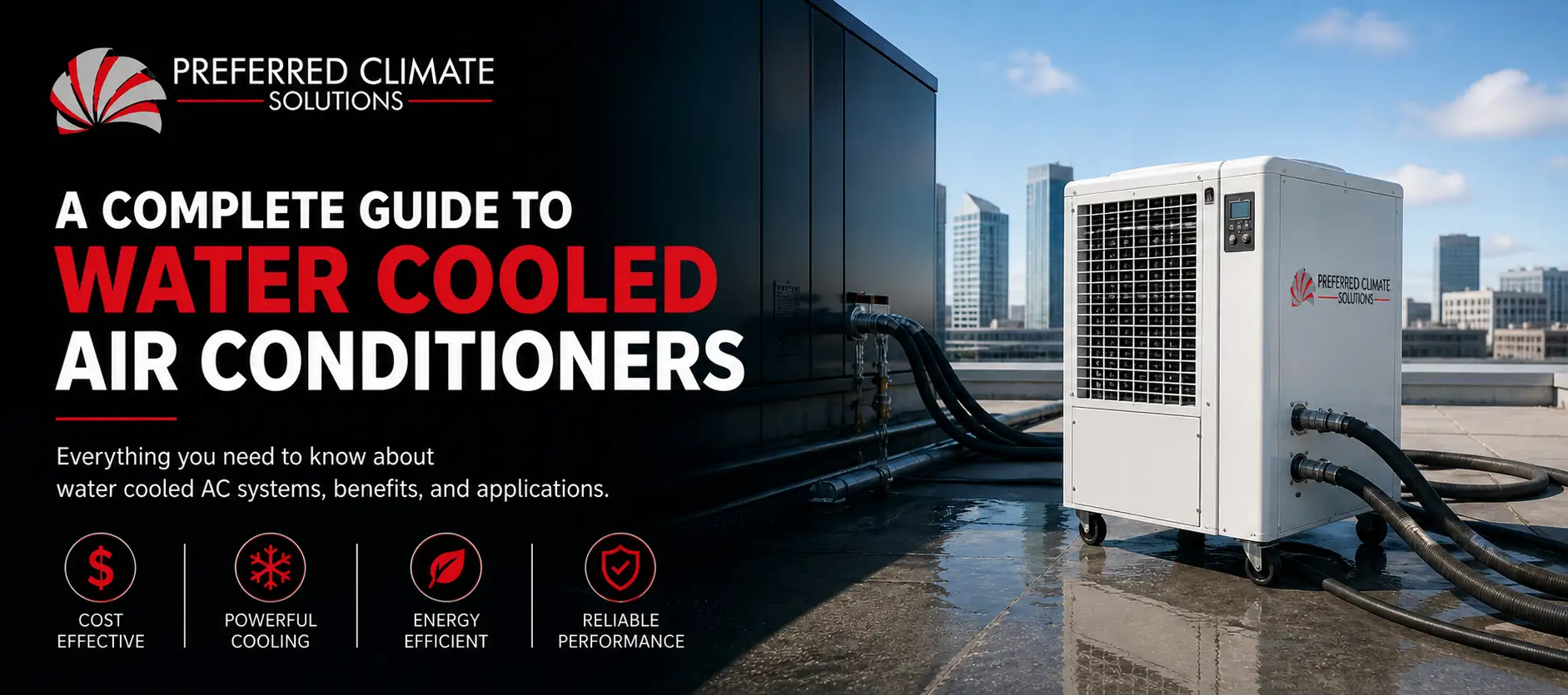
A water-cooled portable air conditioner offers all the thermal efficiency advantages of a fixed system while adding mobility and installation simplicity. Unlike air-cooled portable units that require window kits or ceiling penetrations to exhaust hot air, water-cooled portables manage heat rejection entirely through their water circuit, making them truly duct-free and suitable for fully enclosed spaces where no exterior wall access exists. For facilities exploring a portable air cooler rental, this is often the decisive advantage.
Key operational characteristics that make water-cooled portables uniquely practical:
- Connect to standard sinks or janitorial drains, requiring no specialized plumbing for water supply or wastewater discharge.
- Available in multiple capacities, from compact spot coolers to high-tonnage units for larger commercial needs.
- Easily repositioned within a facility to match changing cooling demands or workspace layouts.
- Ready to operate within hours of delivery, with no ductwork, structural changes, or permits required.
- Ideal for temporary or dynamic environments such as film sets, event venues, workshops, and modular spaces.
These systems offer a fast, flexible, and efficient cooling solution wherever permanent HVAC installation is not feasible or cost-effective.
Critical Factors to Evaluate Before Choosing a Water-Cooled System
Selecting the right water-cooled system, whether for purchase or rental, requires a clear understanding of both technical and operational factors. A well-informed decision helps avoid inefficiencies, unexpected downtime, and unnecessary long-term costs.
- Cooling Capacity: Accurately calculate total heat load (BTUs or tons) to ensure consistent temperature control without overloading or overspending on excess capacity.
- Water Quality & Source: Assess mineral content, pH levels, and flow rate, as poor water quality can lead to scaling, reduced efficiency, and higher maintenance needs.
- Installation Environment: Identify whether the system will be placed indoors or outdoors, considering space, drainage, ventilation, and weather protection requirements.
- Voltage Compatibility: Confirm alignment between facility power supply and equipment specifications to prevent performance issues or equipment damage.
- Noise Level Specifications: Evaluate decibel ratings, especially for noise-sensitive environments like offices, hospitals, or residential-adjacent spaces.
- Total Cost of Ownership: Look beyond upfront costs to include energy usage, water consumption, maintenance, and expected lifespan for a true cost comparison.
- Pump Performance Curves: Ensure the system delivers adequate pressure and flow rate to maintain consistent cooling across all zones.
Carefully evaluating these factors ensures the selected system aligns with your operational needs, budget, and long-term performance expectations.
Common Mistakes to Avoid When Selecting or Renting a Water-Cooled Air Conditioner
Even experienced teams can overlook key factors when choosing or deploying water-cooled systems. Avoiding these common mistakes can save significant cost, time, and operational disruption.
Undersizing the Unit for Actual Heat Load
Relying only on room size often leads to incorrect capacity selection. Factors like equipment heat, occupancy, insulation, and solar gain must be included. Even a 10%–15% undersized unit can struggle during peak demand and wear out faster.
Ignoring Water Quality from the Start
Poor water quality leads to scale buildup, which reduces heat transfer efficiency and increases system strain. Implementing water treatment, such as filtration, chemical inhibitors, and routine descaling prevents long-term performance issues.
Using Air-Cooled Portables in Enclosed Spaces
Air-cooled portable units require proper exhaust. In enclosed areas, hot air can recirculate, reducing cooling effectiveness. Water-cooled portables avoid this issue by removing heat through a water circuit instead of air discharge.
Overlooking Rental as a Short-Term Solution
Purchasing equipment for temporary needs can tie up capital unnecessarily. For seasonal demand, emergencies, or projects, rentals offer flexibility, eliminate maintenance concerns, and provide access to modern, high-efficiency systems.
By addressing these pitfalls early, businesses can ensure better performance, lower costs, and a more reliable cooling strategy.
Are you ready to Experience the Efficiency of Water-Cooled Cooling?
Choosing the right cooling solution directly impacts performance, costs, and reliability. A well-specified water-cooled air conditioner delivers superior efficiency, quieter operations, and unmatched flexibility for demanding environments.
At Preferred Climate Solutions, we help businesses quickly deploy the right system, whether for long-term use or emergency rentals. Our 24/7 team supports everything from portable spot coolers to larger commercial units.
Don’t risk downtime or discomfort. Contact us today to find a reliable and cost-effective cooling solution tailored to your facility’s needs.
Frequently Asked Questions (FAQs)
Can a water-cooled air conditioner operate without a cooling tower?
Yes, smaller or portable units can run without a cooling tower by connecting directly to a water supply and drain. Larger systems typically use cooling towers for efficiency, but not all applications require one.
How much water does a water-cooled system typically consume?
Water usage depends on system size and conditions. A 5-ton portable unit typically uses 1–3 gallons per hour, while larger systems with cooling towers consume more, due to evaporation and blowdown during operations.
Is a water-cooled portable air conditioner more efficient than a standard window AC unit?
Yes, especially in high temperatures. Water-cooled systems maintain consistent cooling performance even above 90°F, while window and air-cooled units lose efficiency, making water-cooled options better for enclosed or heat-intensive environments.
What routine maintenance does a water-cooled system require?
Maintenance includes cleaning condenser components, monitoring water quality, preventing scale buildup, checking pumps and connections, and ensuring proper refrigerant levels. Regular servicing helps maintain efficiency, prevent breakdowns, and extends overall system lifespan.
How quickly can I receive a water-cooled cooler rental for an emergency?
Most providers offer same-day or next-day delivery. Portable units can be installed and operational within hours, requiring only water and power connections, making them ideal for urgent cooling needs or unexpected HVAC failures.
How do I choose the right tonnage (1–5 tons vs larger)?
Start with ~20 BTUs per square foot as a baseline, but adjust for insulation, ceiling height, windows, occupancy, and climate. Homes typically need 1–5 tons, while larger spaces may require higher capacity. A professional Manual J calculation (a standardized method to determine a home’s exact heating and cooling load) ensures precise sizing, preventing inefficiency, uneven cooling, and excess wear from over- or undersized systems.